Most people associate OEE (Overall Equipment Effectiveness) with machines, automation, and traditional manufacturing. But what if your process relies mostly on people, workflow, and coordination instead of equipment?
In a recent project, we successfully adapted OEE to a non-machine environment, and the results were powerful. When you step back from the term “equipment,” OEE is really about evaluating how effectively resources, people, processes, and tools deliver value.
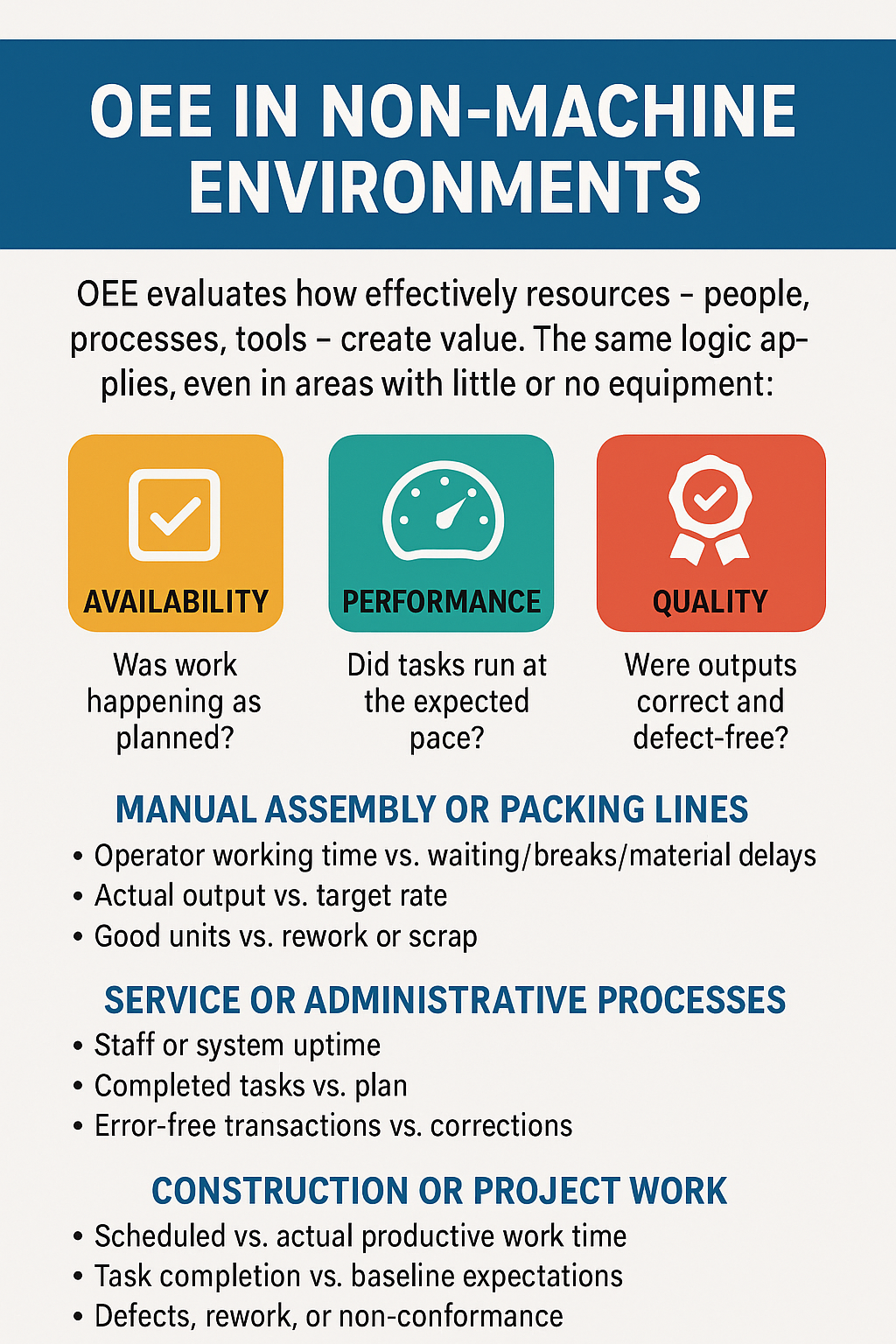
At its core, the same three OEE pillars still apply:
🔹 Availability – Was work happening as planned?
🔹 Performance – Did tasks run at the expected pace?
🔹 Quality – Were outputs correct and defect-free?
Where OEE Works Without Machines
Here are a few examples where OEE applies even when no machine is involved:
1. Manual Assembly or Packing Lines
- Availability: Operator working time vs. waiting/breaks/material delays
- Performance: Actual output vs. target rate
- Quality: Good units vs. rework or scrap
2. Service or Administrative Processes
(order entry, lab testing, logistics, scheduling)
- Availability: Staff or system uptime
- Performance: Completed tasks vs. plan
- Quality: Error-free transactions vs. corrections
3. Construction or Project Work
- Availability: Scheduled vs. actual productive work time
- Performance: Task completion vs. baseline expectations
- Quality: Defects, rework, or non-conformance
Why Extend OEE Beyond Machines?
Organizations benefit from applying OEE concepts in people-driven processes because it:
✔ Highlights bottlenecks and workflow waste
✔ Brings clarity to performance expectations
✔ Improves accountability and problem-solving
✔ Aligns manual, digital, and automated areas with a shared measurement standard
When used correctly, OEE becomes less about equipment and more about effectiveness.
A Practical Tip
Some organizations rename OEE in non-machine environments to reflect this broader focus:
- OPE – Overall Process Effectiveness
- OLE – Overall Labor Effectiveness
- OCE – Overall Crew Effectiveness
These versions keep the same logic but emphasize the human and workflow aspects rather than machines.