
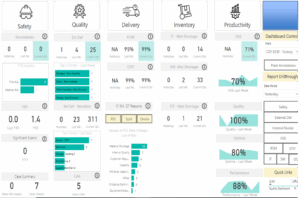
Calgary Project – Increase OEE from 56% to 69% in 3 Months
In today’s manufacturing landscape, organizations are under increasing pressure to improve performance, reduce costs, and consistently deliver high-quality products. The key to meeting these expectations isn’t just working harder—it’s working smarter.
That’s where two powerful tools come in: Overall Equipment Effectiveness (OEE) and SQDIP boards. When combined, they offer a clear path to operational excellence, helping teams measure what matters, act on insights daily, and build a culture of continuous improvement.
What Is OEE?
OEE (Overall Equipment Effectiveness) is a foundational Lean metric used to measure how efficiently a manufacturing process is running. It’s made up of three components:
- Availability – How much time the machine is available for production (vs. downtime)
- Performance – Whether the machine is running at optimal speed
- Quality – The percentage of good parts produced
An OEE score of 100% would mean the equipment is producing only good parts, as fast as possible, with zero downtime. But in the real world, most manufacturers fall between 50% and 60%, especially if they’re just beginning to track performance. While world-class operations aim for 85% and above, the real focus should be on steady, targeted improvement, not chasing a perfect number.
What Is SQDIP?
SQDIP stands for Safety, Quality, Delivery, Inventory, and Productivity—five essential pillars of daily operational performance. SQDIP boards are visual management tools used in tiered daily meetings to track metrics and align frontline actions with strategic objectives.
Each letter reflects a key area:
- S – Safety: Tracks incidents and promotes a safe work culture
- Q – Quality: Monitors defects and rework
- D – Delivery: Measures on-time delivery and schedule adherence
- I – Inventory: Manages materials and finished goods levels
- P – Productivity: Often represented by OEE metrics Together, OEE and SQDIP boards turn data into decisions. They help teams focus, communicate clearly, and stay aligned on performance goals.
Why Integrate OEE with SQDIP Boards?
- Real-Time Visibility: Displaying OEE directly on SQDIP boards allows teams to identify underperformance during their daily huddles. This visibility fosters quick decision-making and reduces the time between identifying a problem and taking corrective action.
- Structured Problem Solving: When an issue arises—like a dip in OEE due to frequent stoppages—it’s logged on the board. Teams can then use tools like the 5 Whys or Fishbone Diagrams to find and fix root causes. This drives sustainable improvement rather than quick fixes.
- Improved Communication & Accountability: Daily tiered meetings give each team a voice. By sharing their metrics, action plans, and challenges openly, they build ownership and foster cross-functional support. Everyone sees the big picture—and their role in improving it.
- Focus on Leading Indicators: Unlike monthly KPI reports, OEE and SQDIP data provide early warnings. For example, a small drop in performance today could signal delivery or quality issues tomorrow. Addressing problems while they’re still small prevents bigger disruptions.
- Daily Kaizen: Continuous improvement, or Kaizen, thrives when it’s part of the daily rhythm. Reviewing OEE and SQDIP metrics each day highlights small opportunities—like standardizing setups or improving maintenance routines—that lead to major gains over time.
- People + Process Alignment: With clear metrics and visual management, everyone from machine operators to plant managers stays aligned. Teams can prioritize based on real-time performance and focus their energy where it has the biggest impact.
- Standardization & Documentation: OEE data, when tracked consistently through SQDIP, promotes documentation of best practices—like quick changeover methods, quality inspection SOPs, and maintenance checklists. These become reference points for training, scaling, and sustaining success.
- Motivation & Engagement: Teams are more engaged when they see the results of their efforts. Hitting a target? Celebrate. Missed one? Let’s solve it together. This daily loop of measurement and action creates a high-trust, high-performance culture.
More Than Tools—They’re Culture Drivers
Used together, OEE and SQDIP go far beyond data collection. They become cultural enablers, reinforcing a proactive mindset where performance is measured, discussed, and improved every day.
These tools help manufacturing organizations:
- Build transparency across shifts and functions
- Empower frontline problem solvers
- Align leadership decisions with real-time shop floor data
- Improve safety, quality, and delivery without increasing cost
It’s not just about hitting numbers—it’s about developing resilient systems that support growth and innovation long term.
About Smart Lean MFG
At Smart Lean MFG, we specialize in helping organizations implement these systems—from assessing current operations to building a daily visual management process grounded in real-time data.
Based in Calgary, we work hands-on with teams that may not have the internal resources to hire a full-time Operational Excellence expert. Our services include:
- Lean and Operations Assessments
- OEE Implementation and Real-Time Monitoring
- Daily Visual Management Boards (SQDIP)
- KPI Development
- Lean, TOC, and Leadership Training
Our implementation philosophy focuses on aligning People, Systems, and Processes—because that’s how true transformation happens. We don’t just consult—we coach, train, and guide your team from concept through execution, ensuring the improvements stick.
